I built a Jarvis for myself. Here's what it actually does.
I wanted a system that actually builds a deep, evolving understanding of me over time - across every app and agent I use.

If i have to define AGI in one word, what comes to my mind is Tony Stark's Jarvis. Not the "set a timer" kind of assistant, Jarvis was literally 'Just A Rather Very Intelligent System'. It understood Tony. It had context. It knew what happened yesterday and why it mattered today.
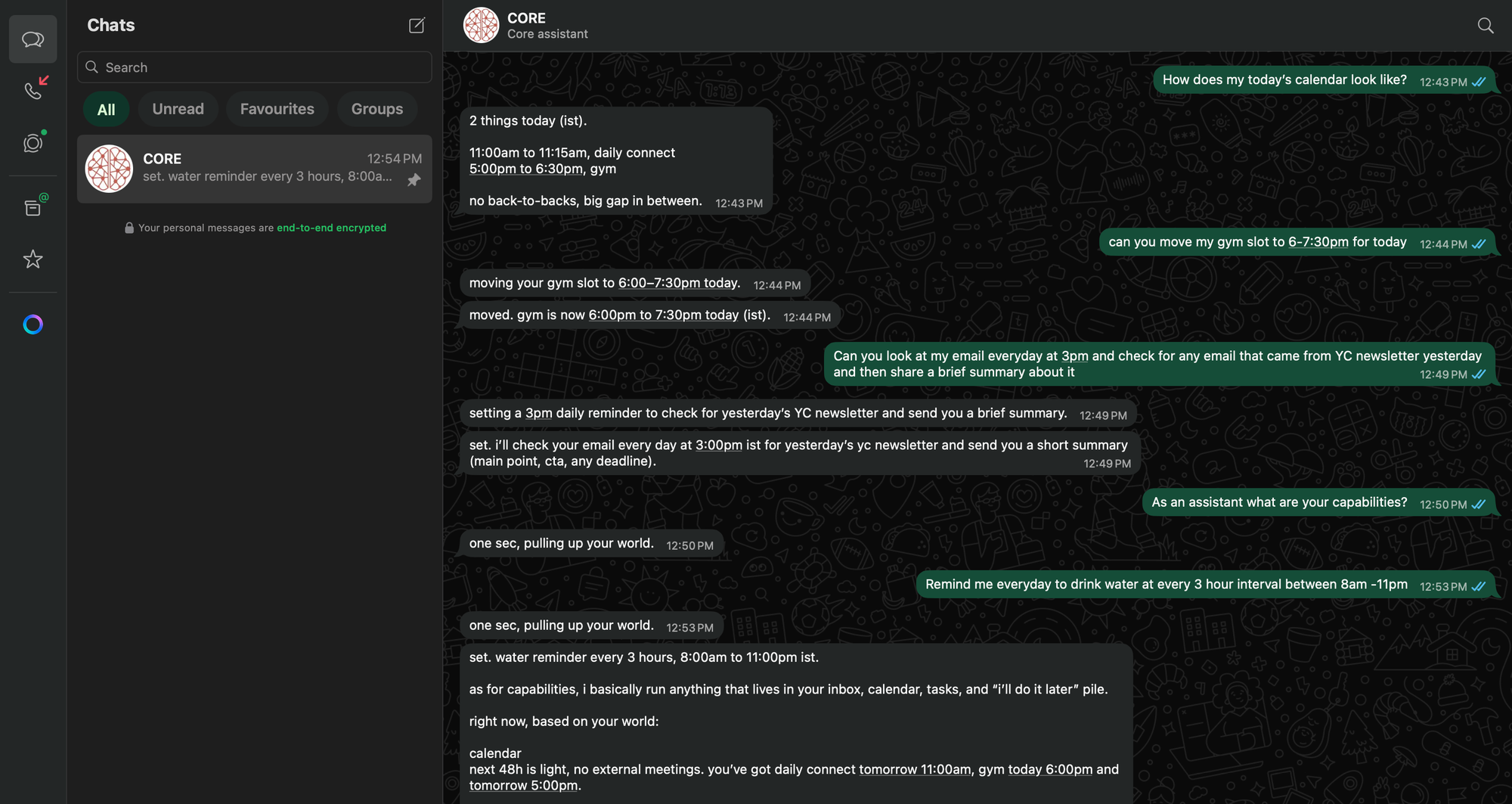
Openclaw gave us the first glimpse of what that could look like, doing complex tasks just by talking to an agent on whatsapp. That was exciting.
But it wasn't cutting it as my jarvis. The reason: it didn't really know me. Openclaw has memory.md, soul.md and a bunch of other files. But those are flat text files that get appended or overwritten. No understanding of when i said something, why i changed my mind, or how facts connect. If i switched from one approach to another last month, it can't tell you why that context is gone.
I also wanted the system to be omnipresent. Not restricted to one channel. I should be able to connect it with any app, any agent, and it shares understanding about me across all of them.
What my mornings look like now
Every day at 9am, my system wakes up on its own. No prompt from me.
It reads yesterday's emails, checks today's calendar for meetings needing prep, pulls recent github activity, and sends me a clean summary on whatsapp before i've opened my laptop.
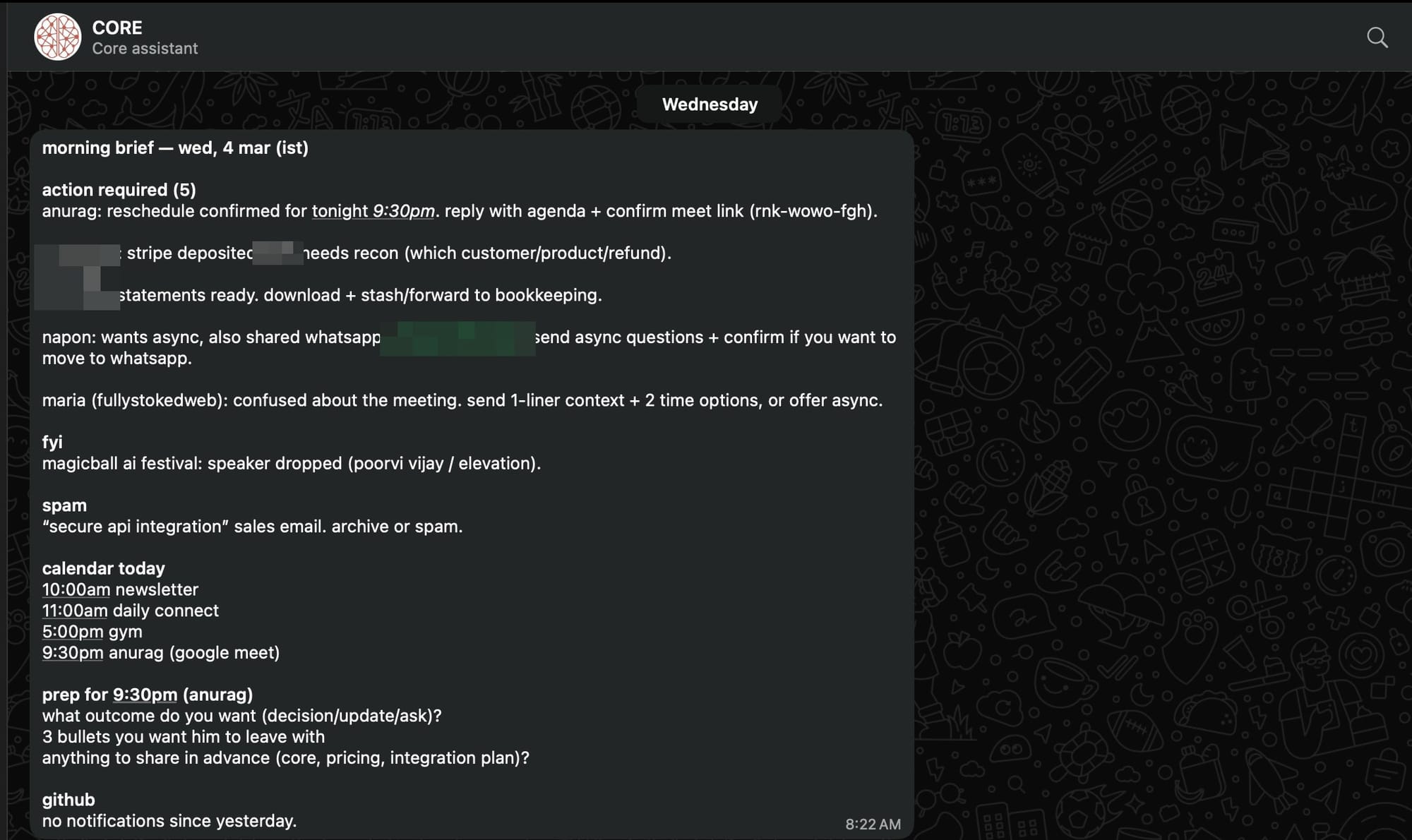
Setting this up is super simple
connect your apps on the dashboard -> add "morning brief" skill from library -> create a reminder, pick whatsapp as channel.
Done. Even for a non-technical user.
Spinning up claude code from whatsapp
Here's something i did just yesterday. I needed to build a new posthog integration. Instead of sitting at my desk, i messaged my system on whatsapp: "start a claude code session, work on the posthog integration, here's the github issue for context."
It spun up claude code on my machine remotely, created a new branch, pulled repo context, scanned existing integration patterns, and built the whole thing. I checked in later commit was ready, files were all there.
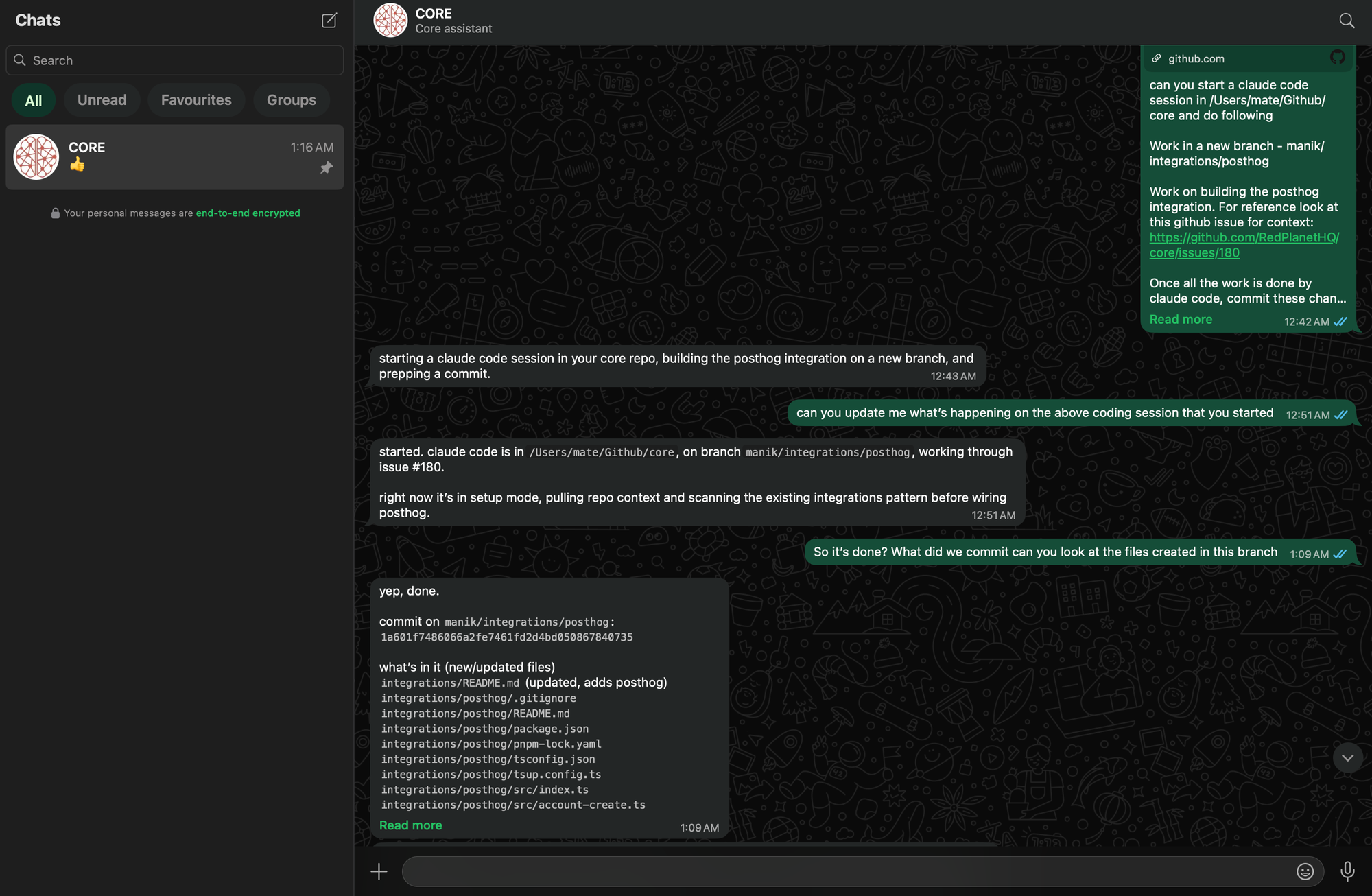
This works through the Gateway - a local service on your machine that connects to core's agent. Coding agents, browser automation, shell commands all are accessible remotely.
Combine this with scheduling and it gets interesting. I've set up a job: every Monday at 2pm, i've asked core to look at the last week commits and create the product changelog and add it in in the docs.
The memory is what makes this personal
Most ai memory systems work like a notebook, it append facts, overwrite old ones, no sense of time or relationships.
We built a temporal knowledge graph instead. Every conversation, decision, and preference from every app and agent flows into one graph. Entities get extracted and connected. Contradictions are preserved with timestamps, not overwritten. Search uses keyword matching, semantic search, and graph traversal simultaneously.
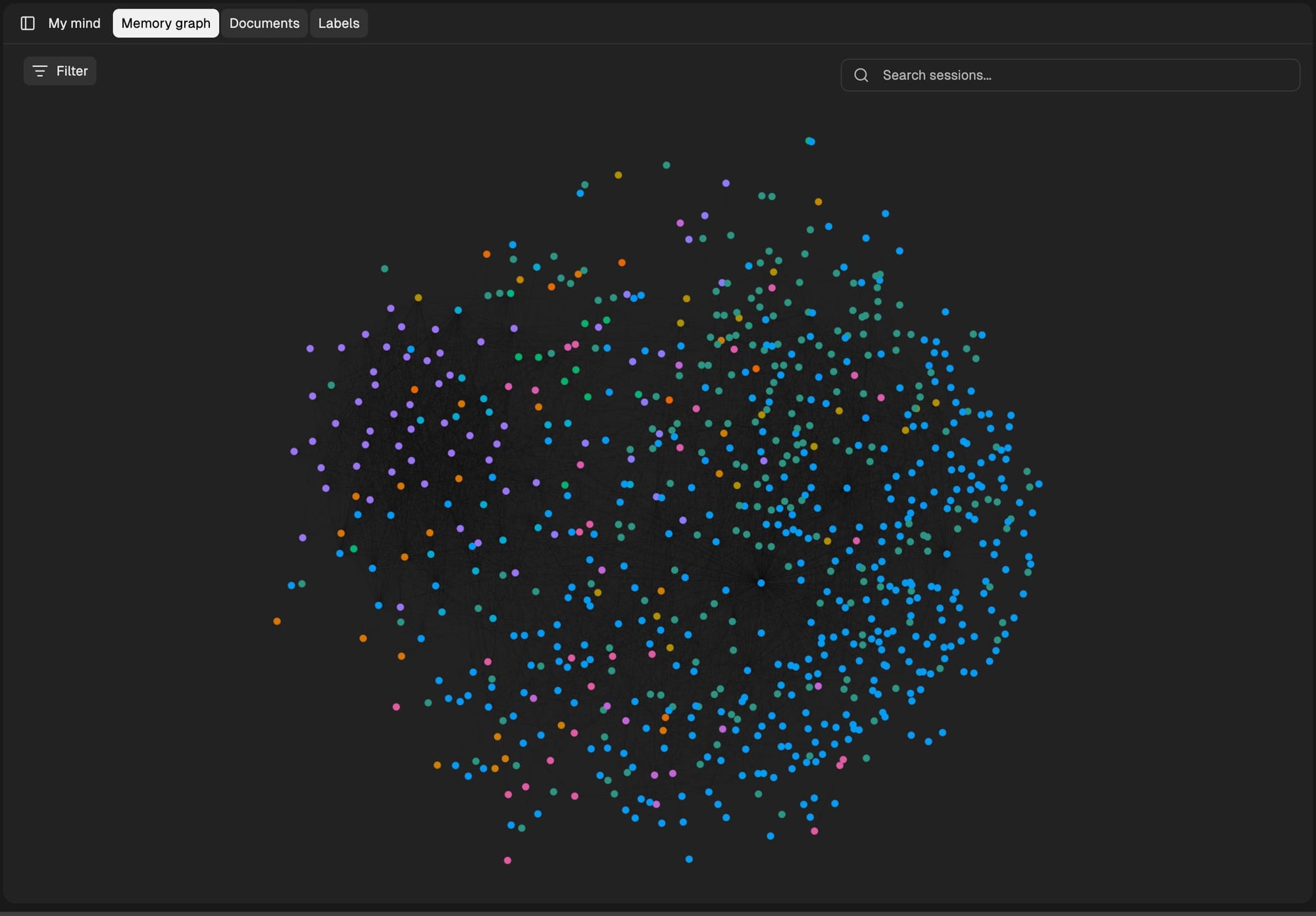
What that means practically: my coding agent knows what i discussed in chatgpt/gemini. My email assistant knows bugs i fixed in claude code. One memory, shared everywhere.
Connection is simple, for coding agents you add one MCP url. For chatgpt/gemini there's a browser extension. Everything flows into the same graph.
We benchmarked this on the LoCoMo dataset - 88.24% accuracy across all reasoning tasks, outperforming mem0, memobase, and zep.
Other things i run on it
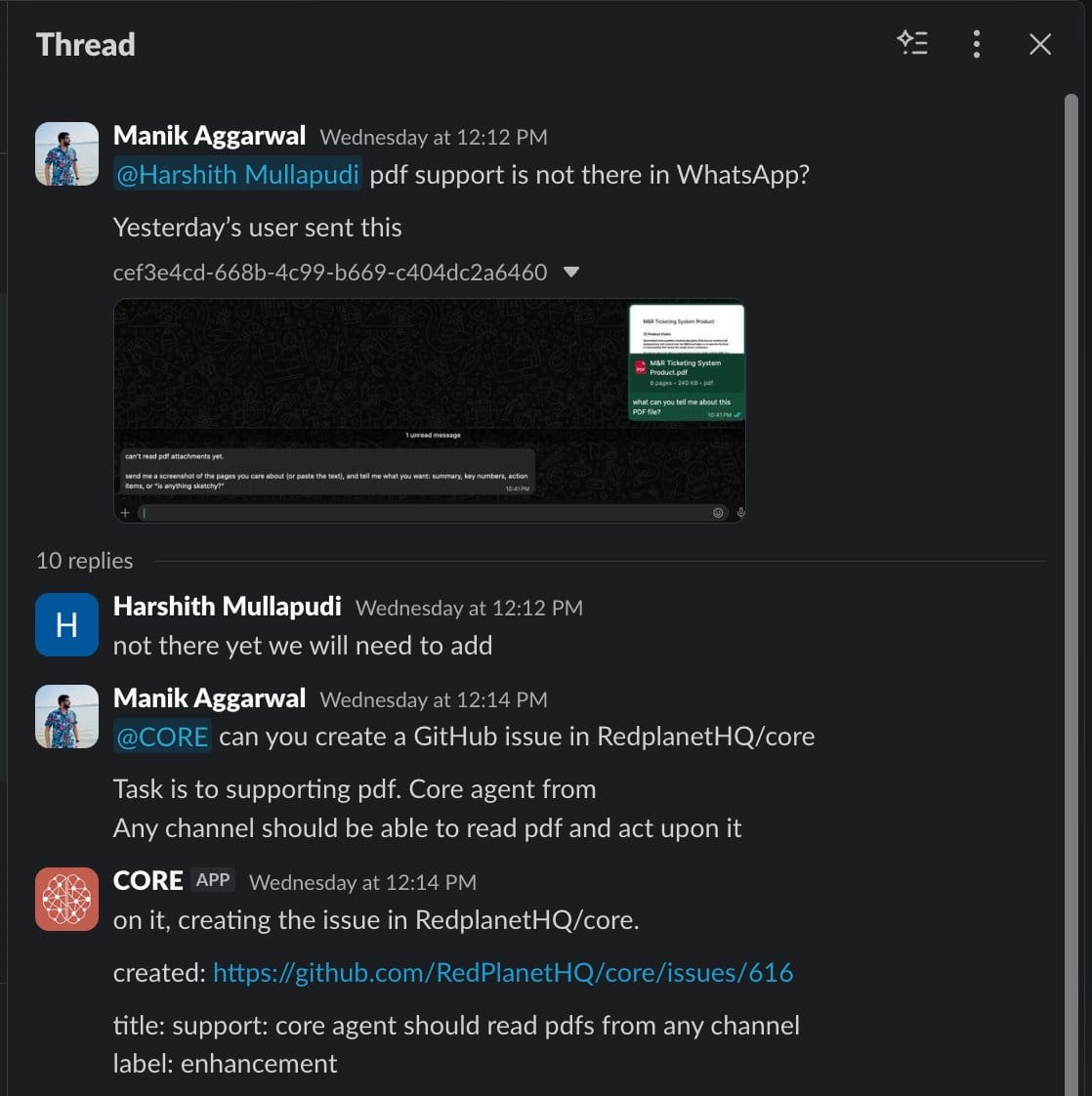
- Creating Issues in Github directly from slack
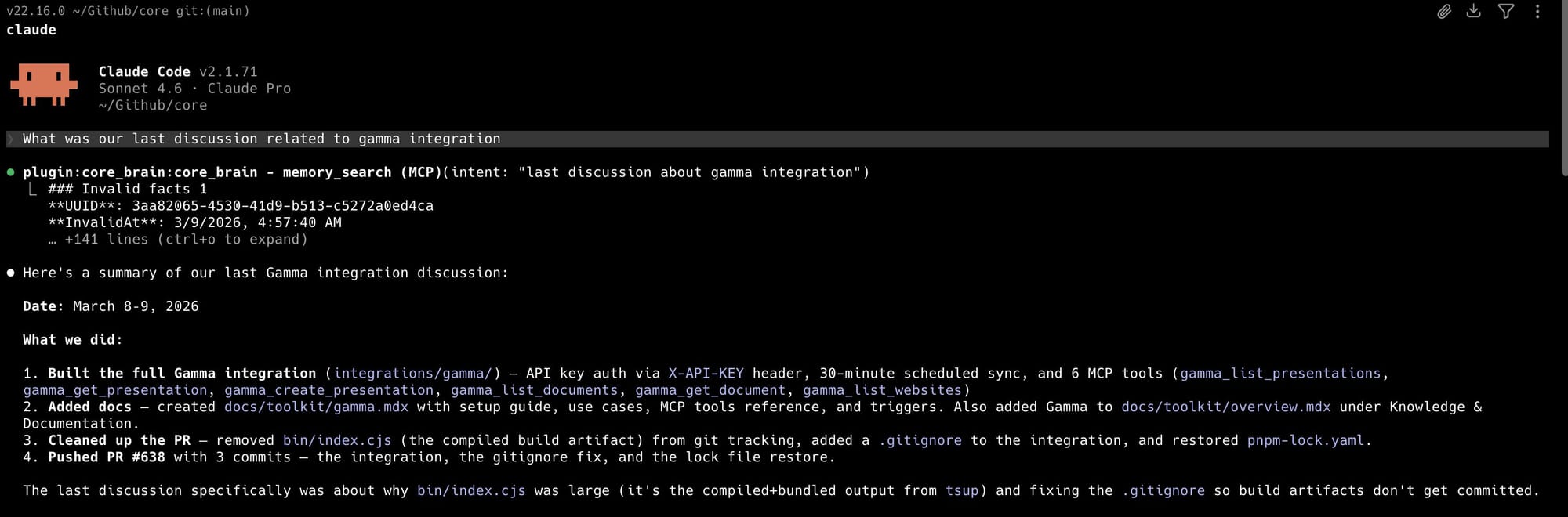
- Make claude code remember about our past discussions so i don't have to repeat myself
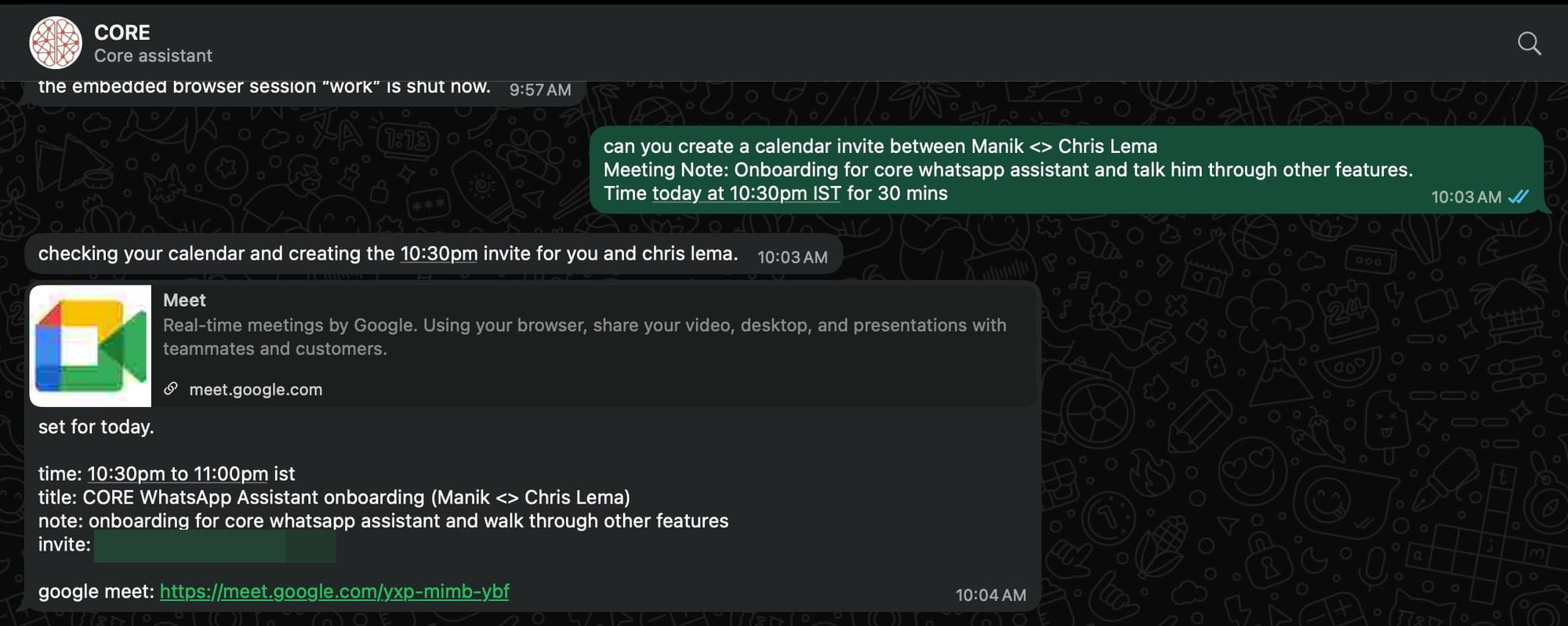
3. Create my calendar invites
And much more..
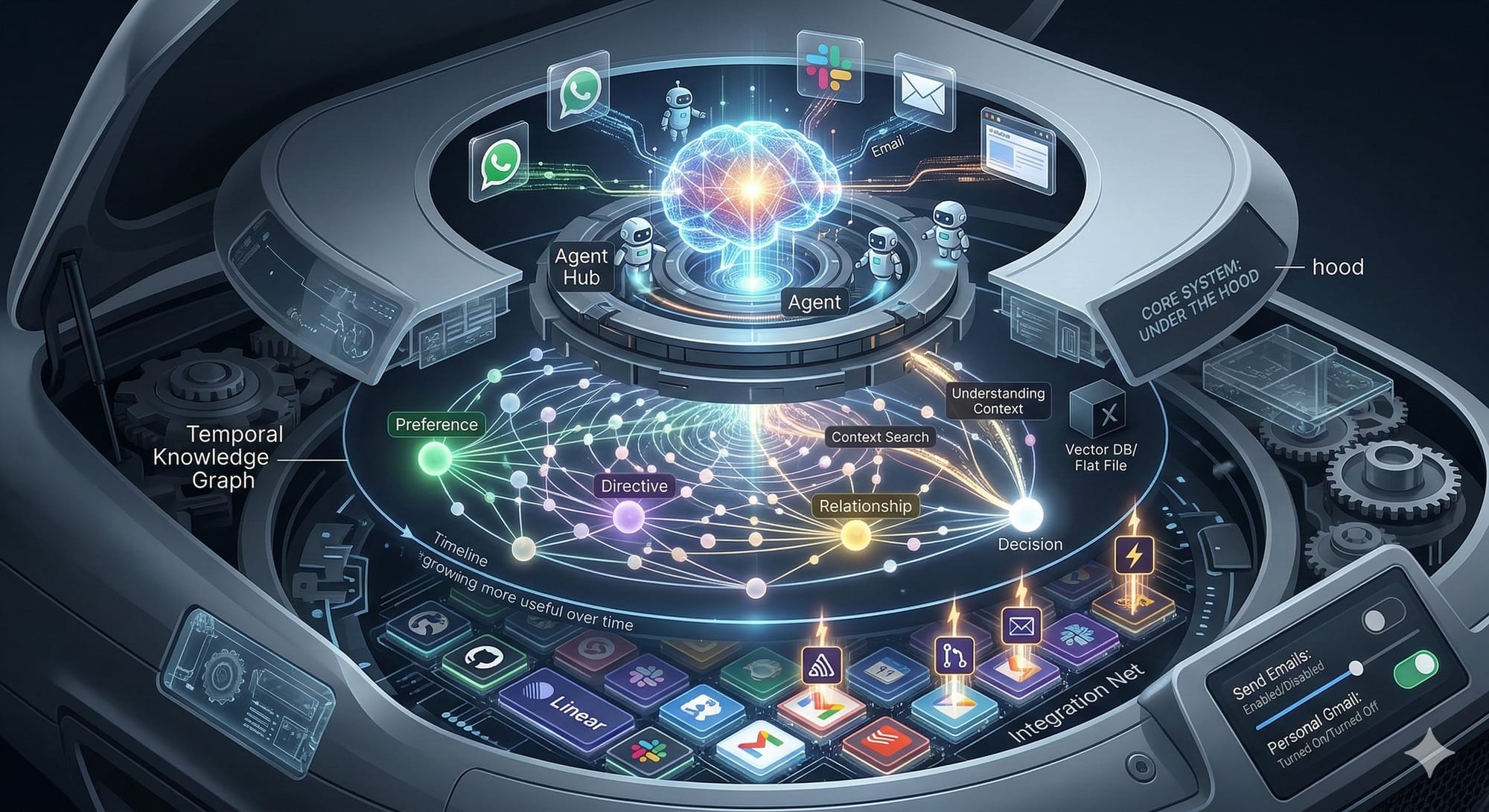
What's under the hood
CORE system is primarily made of three layers:
Agent: The Orchestrator
When you send a message from any channel, the agent figures out what to do. It searches memory for relevant context, picks the right integration tools, follows skill instructions, and decides whether to handle the task itself or spin up a specialized agent like Claude Code. It's channel-agnostic - whatsapp, slack, email, web dashboard all hit the same brain with the same memory
Memory: Temporal Knowledge Graph
This is the core differentiator, no pun intended. It's not a vector db or a flat file. A temporal knowledge graph where every fact is categorized (preference, decision, directive, goal, relationship) and connected to other facts over time. When you search, it doesn't just match keywords, it understands what you're looking for, traverses relationships between concepts, and pulls context you didn't explicitly ask for but need. This is why the system gets more useful the longer you use it.
Integrations
30+ apps connected via MCP tools (GitHub, Linear, Slack, Gmail, Calendar, Todoist, etc). But the real power is webhooks: the agent doesn't wait for you. A new email arrives, a sentry alert fires, a PR gets merged, it wakes up (if you want it to) and evaluates what happened against what it knows about you and decides whether to act, notify, or stay quiet.
Everything is configurable from the dashboard. Don't want it sending emails? Disable that tool. Don't want it reading personal gmail? Turn off the connector.
It's fully open-source
We offer two ways to use it:
Hosted: sign up at app.getcore.me, connect your first agent in under 5 minutes. No infra to manage.
Self-hosted: clone the repo, docker-compose up, done in ~15 minutes. Needs 4gb ram. You can also deploy it on Railway.
The open-source path exists for a reason. If i'm asking you to give an AI system access to your emails, calendar, and code you should be able to see exactly what it does with that data. No black boxes. No trust-me. Read the code.
Repo: https://github.com/RedPlanetHQ/core